How does a Low-E Glass Work in Hot and Cold Climates?

How does a Low-E Glass Work in Hot and Cold Climates?
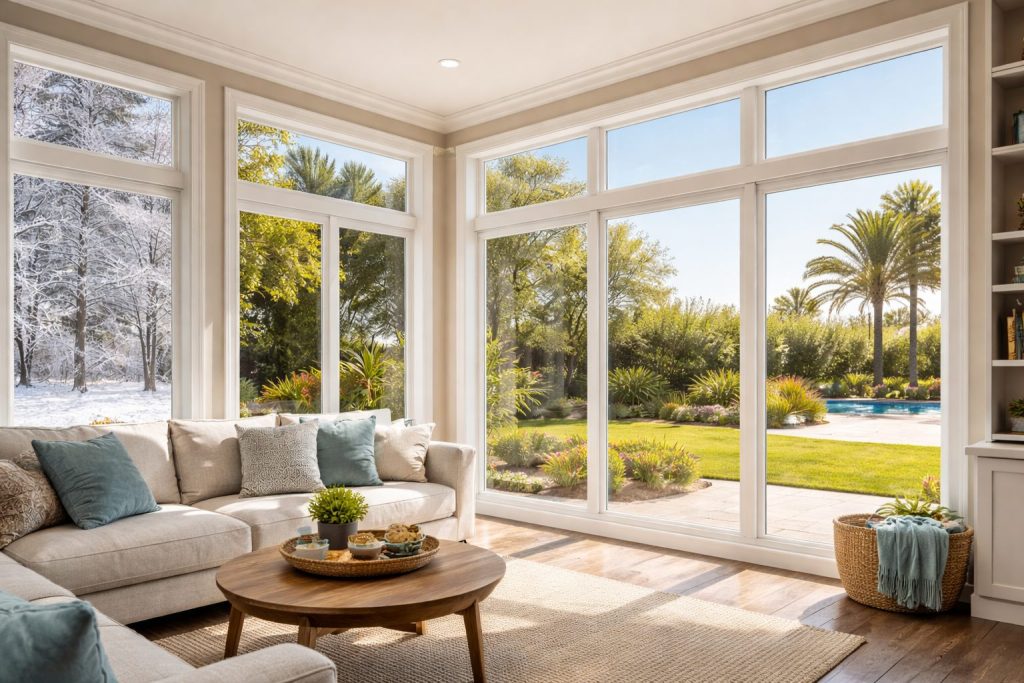
Low-E Glass Benefits: How It Works and Why It Matters in Hot and Cold Climates
When homeowners think about energy efficiency, roofing usually gets the spotlight. But your windows play just as critical a role in how your home performs — especially in extreme climates.
If you live in Arizona’s desert heat, New Jersey’s freezing winters, Florida’s humidity, or Utah’s temperature swings, your windows are constantly battling the elements. And one of the most important technologies protecting your comfort year-round is something you can’t even see:
Low-E glass.
Low-E (low emissivity) coatings have transformed how modern windows perform. They reduce energy loss, improve comfort, protect interiors, and help stabilize indoor temperatures — all while remaining virtually invisible.
In this guide, we’ll break down:
- What Low-E glass actually is
- How it works
- Why it matters in hot climates
- Why it matters in cold climates
- The difference between coating types
- How it impacts your energy bills
- When it makes sense to upgrade
- How it works with your roof and insulation system
And most importantly — whether your home should have it before the next season hits.
Introduction to Energy-Efficient Windows
When it comes to improving your home’s energy efficiency, windows are one of the most impactful upgrades you can make. Energy-efficient windows are specifically engineered to minimize heat loss during cold weather and reduce solar heat gain in hot climates, helping to create a more comfortable and cost-effective living environment year-round.
At the heart of these high-performance windows are low-e coatings—ultra-thin, transparent layers applied to the glass, often thinner than a human hair. These advanced coatings are designed to control the amount of heat that enters or escapes your home, making a significant difference in both energy bills and indoor comfort. By reflecting the sun’s heat away during summer and retaining warmth inside during winter, low-e glass works to reduce both cooling costs and heating expenses, no matter the season.
The effectiveness of energy-efficient windows is measured by two key factors: the solar heat gain coefficient (SHGC) and the U-factor. The SHGC indicates how much solar radiation passes through the window, while the U-factor measures the rate of heat transfer. For homeowners in hot climates, selecting windows with a lower SHGC is essential for reducing solar heat gain and keeping interiors cooler. In colder climates, a low U-factor helps to reduce heat loss and maintain a cozy indoor temperature. Choosing the right combination for your specific climate can lead to substantial energy savings and improved energy performance.
Energy Star Label Windows
One of the best ways to ensure your new windows deliver on energy efficiency is to look for the Energy Star label. Energy Star certified windows are rigorously tested to reduce energy loss and can help lower household energy bills by up to 13 percent nationwide when replacing older, single-pane windows. Beyond saving energy and money, these windows also help reduce greenhouse gas emissions, making them a smart choice for environmentally conscious homeowners.
Other important factors that influence window performance include orientation—such as north facing windows or west facing windows—and the use of window treatments that provide shade and further reduce solar heat gain. Materials with low emissivity, like low-e glass, are especially effective in warmer climates where blocking the sun’s heat is a priority. Additionally, protecting interior surfaces from UV light helps prevent fading of fabrics, flooring, and furnishings, preserving the value and beauty of your home.
Selecting the right windows for your house isn’t a one-size-fits-all decision. Trained professionals can help you assess your home’s unique needs, taking into account climate, window direction, and other factors to recommend the best energy-efficient options. Proper installation is also crucial to maximize the benefits of your investment.
In summary, energy-efficient windows equipped with low-e coatings offer a range of benefits: lower energy bills, enhanced comfort, and protection for your interior surfaces. By understanding how low-e glass works and considering the factors that impact energy performance, homeowners can make informed choices that save energy, improve comfort, and contribute to a more sustainable home.
What Is Low-E Glass?
Low-E glass stands for low emissivity glass.
Emissivity refers to a material’s ability to radiate heat. Standard glass has relatively high emissivity, meaning it allows heat to pass through more freely.
Low-E glass has a microscopically thin metallic coating applied to its surface. This coating is invisible to the naked eye but dramatically changes how the glass interacts with heat and light.
The coating reflects infrared heat while allowing visible light to pass through.
In simple terms:
- It keeps heat out when it’s hot.
- It keeps heat in when it’s cold.
That dual function is what makes Low-E glass valuable in both extreme heat and freezing temperatures.
The Science Behind Low-E Glass
To understand how Low-E works, you need to understand three types of energy transfer:
- Conduction – Heat moving through materials
- Convection – Heat moving through air
- Radiation – Heat transferred as infrared energy
Windows lose or gain most of their heat through radiation.
Sunlight contains:
- Visible light
- Ultraviolet (UV) rays
- Infrared (IR) heat energy
Low-E coatings are designed to:
- Reflect infrared heat
- Reduce UV penetration
- Allow visible light inside
The coating acts like a thermal mirror.
In summer, it reflects exterior heat away from your home. In winter, it reflects interior heat back into the room.
The effectiveness of Low-E glass is measured using ratings such as U-Value, SHGC (Solar Heat Gain Coefficient), and VLT (Visible Light Transmittance). These ratings measure how well the Low-E coating reduces UV and infrared transmission and impacts overall energy efficiency.
This is why Low-E windows are effective in both hot and cold climates.
Why Low-E Glass Matters in Hot Climates
In states like Arizona, New Mexico, Utah, and Florida, cooling costs dominate annual energy bills.
Without Low-E glass, direct sunlight pours infrared heat and the sun’s heat directly through windows. That heat raises indoor temperatures, forcing your HVAC system to work harder.
In extreme heat, this creates:
- Hot spots near windows
- Overworked AC systems
- Higher electricity bills
- Increased humidity imbalance
- Faster furniture fading
Low-E glass cuts glare from direct sunlight while allowing ample natural light, improving visibility and comfort.
Low-E glass reduces solar heat gain.
Solar Heat Gain Coefficient (SHGC) measures how much solar radiation passes through a window. Lower SHGC values mean less heat enters.
In desert climates like Arizona:
Low-E coatings reduce heat load, meaning your air conditioner cycles less frequently and maintains more consistent comfort.
In humid climates like Florida:
Low-E helps control solar heat and reduces strain on dehumidification systems.
In both cases, the result is:
- Lower cooling demand
- More stable indoor temperature
- Reduced HVAC wear
- Increased comfort near windows
Low-E coatings can help block the sun’s heat in summer and prevent heat from escaping in winter.
Why Low-E Glass Matters in Cold Climates
In colder regions like New Jersey or high-elevation Utah communities, heat retention becomes the priority.
During winter, standard windows allow interior heat to escape outward.
Low-E coatings reflect interior heat back inside the home.
This reduces:
- Cold drafts
- Interior heat loss
- Furnace runtime
- Condensation on glass
When interior warmth reflects inward instead of escaping, your heating system works less aggressively.
In cold climates, this leads to:
- Lower heating bills
- More comfortable indoor temperature
- Reduced cold spots near windows
- Less window condensation
Low-E doesn’t just block heat — it manages it intelligently.
Does Low-E Glass Block Light?
This is a common concern.
No — Low-E coatings are virtually invisible.
They allow visible light transmission while filtering infrared heat and UV rays.
Your home stays bright without the heat overload.
This is especially important in homes with:
- Large picture windows
- South-facing exposures
- High glass-to-wall ratios
- Open-concept designs
You get natural light without sacrificing efficiency.
The Two Main Types of Low-E Coatings
Not all Low-E glass is the same.
There are two different types of low-e coatings: passive low-e coatings and solar control low-e coatings. Passive low-e coatings are designed to maximize solar heat gain into a home or building, while solar control low-e coatings are intended to reduce solar heat gain. Low-e coatings are transparent metallic layers applied to the surfaces of glass and can be tailored to specific climates.
Low-e coatings can be applied to multiple glass surfaces of an insulated glass unit (IGU). In a standard double IGU, there are four potential surfaces to which coatings can be applied. Passive low-e coatings function best when applied to the third or fourth surface of an IGU, while solar control low-e coatings function best when applied to the second surface.
There are two primary coating methods used by manufacturers: pyrolytic, or ‘hard coat,’ and Magnetron Sputter Vacuum Deposition (MSVD), or ‘soft coat.’ The choice of production method by the manufacturer impacts the performance and application of low-e glass. It is important to choose products from reputable manufacturers to ensure optimal energy efficiency.
Window manufacturers often apply these specialized coatings during the manufacturing process to enhance energy efficiency and occupant comfort.
1. Hard Coat (Passive Low-E)
- Applied during glass manufacturing
- More durable
- Allows more solar heat gain
- Better suited for cold climates
Passive Low-E is often used in regions where winter heating benefits from solar gain.
2. Soft Coat (Solar Control Low-E)
- Applied in a vacuum chamber
- More advanced performance
- Reflects more infrared heat
- Better suited for hot climates
Soft coat Low-E is commonly used in warmer regions to reduce solar heat penetration.
The right option depends on your climate and window orientation.
Low-E Glass and UV Protection
UV rays cause:
- Flooring fading
- Furniture discoloration
- Curtain deterioration
- Artwork damage
Low-E coatings significantly reduce UV transmission.
This protects interior finishes and extends the life of furnishings.
In sun-intense regions like Arizona and Florida, this protection matters more than most homeowners realize.
How Low-E Glass Impacts Energy Bills
Energy efficiency improvements compound over time.
When Low-E glass reduces solar heat gain:
- Air conditioning cycles decrease
- Compressor wear reduces
- Monthly energy bills drop
When Low-E glass reduces winter heat loss:
- Furnace cycles decrease
- Heat retention improves
- Gas or electric usage declines
Savings vary based on:
- Climate
- Window size
- Insulation
- Roof performance
- HVAC efficiency
But across both hot and cold climates, Low-E glass consistently improves thermal performance.
The Role of Low-E Glass in Whole-Home Performance
Windows do not operate in isolation.
They interact with:
- Roofing materials
- Attic insulation
- Ventilation systems
- Exterior siding
- Air sealing
Energy-efficient doors and skylights, when combined with Low-E glass windows, further improve home comfort and energy savings.
At Reimagine Roofing, we evaluate your home as a system.
For example:
In Arizona, combining reflective roofing with Low-E windows dramatically reduces overall cooling load.
While in New Jersey area, pairing proper attic insulation with Low-E glass improves winter heat retention.
In the state of Florida, sealed roofing systems combined with Low-E glass reduce humidity and temperature fluctuations.
Energy performance is cumulative.
Signs You Should Consider Low-E Windows
You may benefit from Low-E glass if:
- Your energy bills are rising
- Rooms near windows feel hot in summer
- You experience cold drafts in winter
- Furniture is fading
- Your windows are 15+ years old
- Glass feels hot to the touch in sunlight
- You see interior condensation in winter
Older windows without coatings are far less efficient.
Does Low-E Work in Mixed Climates?
Yes.
In regions like Utah or New Jersey where summers are warm and winters are cold, dual-performance coatings are available.
Modern window systems balance:
- Moderate solar gain in winter
- Reduced solar gain in summer
- Year-round thermal insulation
Selecting the right SHGC and U-factor values ensures proper balance.
Low-E Glass and Double or Triple Pane Windows
Low-E coatings perform best when combined with:
- Double-pane windows
- Triple-pane systems
- Argon or krypton gas fills
The gas fill reduces conduction.
The Low-E coating manages radiation.
Together, they create superior insulation.
Myths About Low-E Glass
Myth 1: It makes rooms darker
False — visible light transmission remains high.
Myth 2: It’s only useful in cold climates
False — it’s extremely beneficial in hot climates.
Myth 3: It’s expensive and unnecessary
Energy savings and comfort improvements often offset cost over time.
Regional Benefits by Reimagine Service Area
Arizona & New Mexico
- Extreme solar intensity
- Cooling load reduction
- UV protection critical
Utah
- High elevation sun exposure
- Winter heat retention important
Florida
- Heat + humidity
- Reduced solar gain lowers AC strain
New Jersey
- Cold winters
- Summer heat waves
- Balanced performance needed
Low-E glass performs differently based on orientation and region. That’s why evaluation matters.
Should You Upgrade Before the Next Season?
If your windows are aging, inefficient, or underperforming, upgrading before peak season reduces:
- Emergency repairs
- HVAC overload
- Comfort fluctuations
- Long-term energy waste
Energy upgrades are proactive — not reactive.
How Reimagine Roofing Helps
While roofing is our specialty, we understand that full exterior performance matters.
When we inspect homes, we evaluate:
- Roof reflectivity
- Attic insulation
- Ventilation balance
- Window performance
- Exterior envelope integrity
We provide honest recommendations based on climate, budget, and long-term goals.
Invisible Technology, Visible Comfort
Low-E glass isn’t flashy.
You won’t notice it when you look at your windows.
But you will notice:
- More comfortable rooms
- Reduced HVAC cycling
- Lower energy bills
- Protected interiors
- Fewer temperature swings
In both hot and cold climates, Low-E glass is one of the most effective invisible upgrades you can make.
Upgrade Your Home’s Performance Before the Next Season Hits
If your home struggles with heat, cold drafts, rising energy bills, or aging windows, now is the time to act.
Reimagine Roofing and Construction provides comprehensive exterior evaluations designed to identify where your home is losing efficiency — from roofing to ventilation to window performance.
Schedule your free windows assessment today and receive a fast, detailed quote so you can improve comfort, reduce energy costs, and prepare your home for whatever climate challenges come next.
Don’t wait for another extreme season to test your home’s weaknesses.
Upgrade smart. Upgrade before the next heat wave or cold front arrives.
Popular Posts